The Great Migration
The sheer scale of the Great Migration is something that hits you long before the dust even clears. Millions of hooves churning the soil, a collective heartbeat moving across the Serengeti plains driven by pure instinct. Capturing that endless, raw momentum in a single frame isn't just about documenting a wildlife event—it is about capturing the fragile, powerful rhythm of life itself.
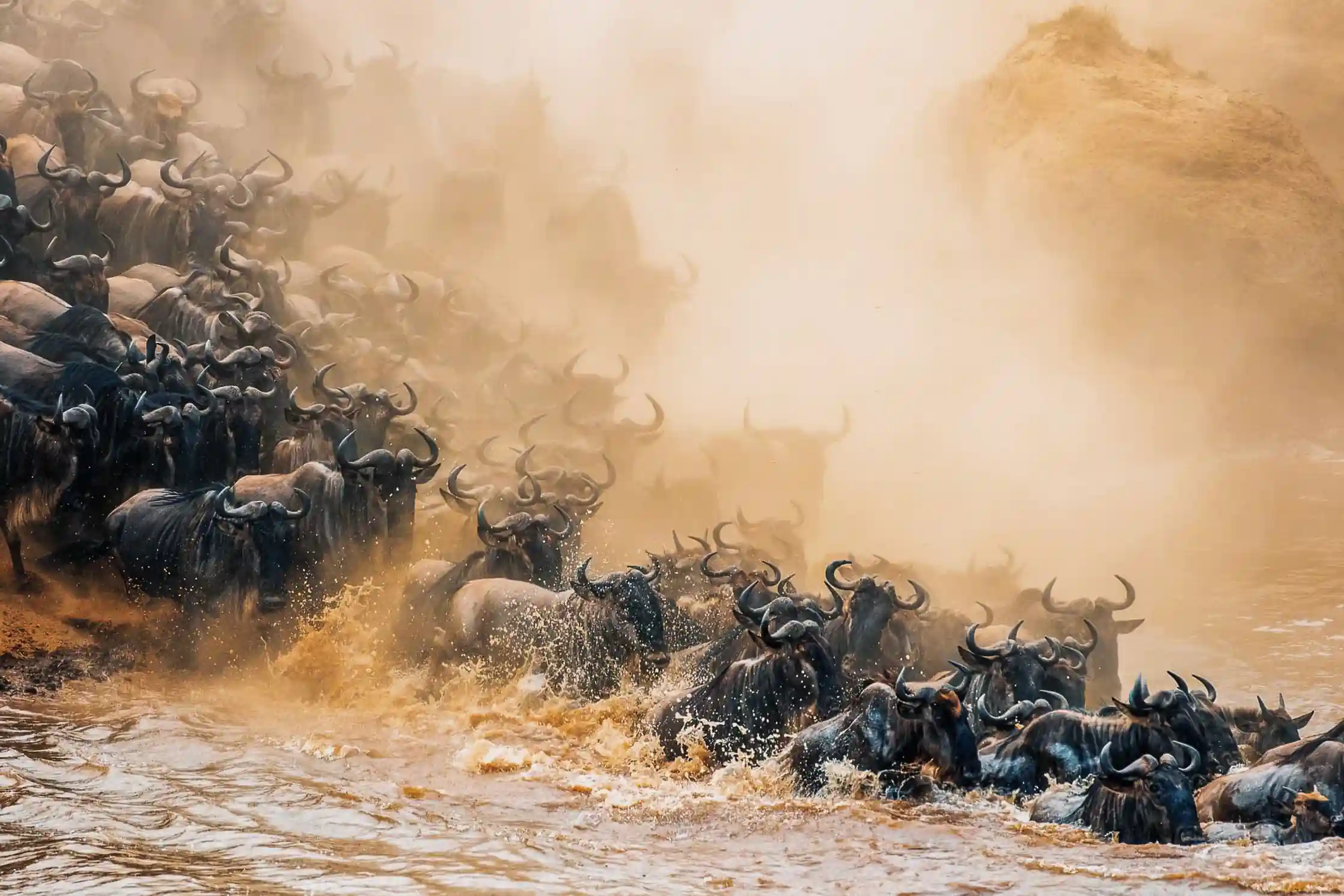
Driven by the relentless search for fresh grass and water, the Great Migration operates on a continuous, clockwise loop across the Serengeti-Mara ecosystem. It is an endless journey dictated entirely by seasonal rainfall patterns, transitioning through four distinct phases:
January – March: The Calving Season (Southern Serengeti & Ndutu)
The cycle anchors itself on the rich, nutrient-dense short-grass plains of Ndutu and the southern Serengeti. Triggered by the short rains, the mega-herds settle here to give birth. Over a synchronized two-to-three-week window in February, roughly 500,000 wildebeest calves are born—up to 8,000 a day. This massive concentration of vulnerable young turns the southern plains into a high-stakes arena for apex predators, offering raw, fast-paced wildlife action against a lush green backdrop.
April – June: The Trek North & The Rut (Central to Western Corridor)
As the southern pastures dry up and the long rains set in, the herds begin moving northwest in massive columns that can stretch for miles. They pass through the central Seronera valley and head into the Western Corridor. By May and June, the breeding season (the rut) is in full swing, filling the air with the deep, resonant grunts of competing males. By late June, the vanguard of the migration reaches the banks of the Grumeti River, facing their first major geographical barrier and the oversized Nile crocodiles waiting there.
July – October: The Perilous River Crossings (Northern Serengeti)
This is the most iconic and dramatic phase of the journey. As the dry season takes hold, the herds push into the northern Serengeti at Kogatende and Lamai. To reach the green pastures of the Maasai Mara, they must plunge across the fast-flowing, crocodile-infested waters of the Mara River. The crossings are chaotic, unpredictable, and visually spectacular. Thousands of animals cross back and forth across the Tanzanian-Kenyan border throughout these months, following localized rain clouds.
November – December: The Return Journey (Eastern Serengeti)
When the short rains begin to break in the south, the herds instantly sense the shift. They turn back, moving rapidly down the eastern flank of the Serengeti through the Lobo area. This is a time of steady, purposeful movement as the animals cover vast distances to return to where the journey started, arriving just in time for the nutrient-rich grasses to sprout anew on the southern plains before the next calving season begins.