Mobile Photography vs DSLR for Large and Archival Prints: A Professional Print Guide
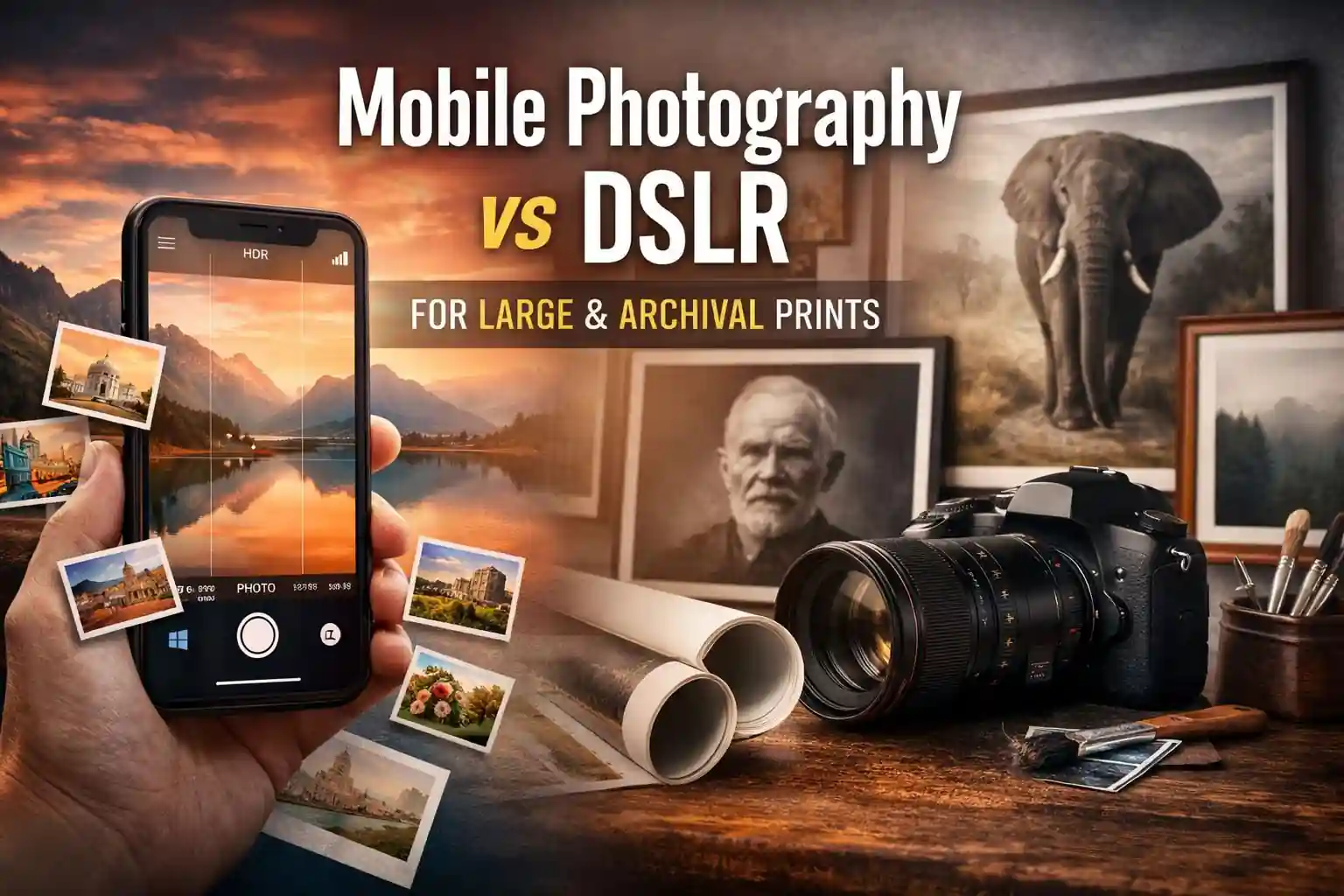
Can smartphone photography compete with DSLR cameras for large wall prints and archival-quality photographs? This guide from ClickedArt, a professional printing company and art gallery based in Lucknow, explains how mobile and DSLR images perform in real-world printing, which print sizes work best, and how archival printing and framing impact final output.
Introduction
Smartphone cameras have evolved rapidly, offering high megapixel sensors, AI image processing, and RAW capture. This has led photographers, artists, and art buyers to ask an important question.
Can mobile photography deliver the same quality as DSLR cameras for large and archival photo prints?
At ClickedArt, a professional printing company and art gallery based in Lucknow, we work with images captured on both smartphones and DSLR or mirrorless cameras. The answer depends on print size, image quality, and how the photograph is printed and preserved.
Mobile photography can produce impressive results. However, for large-format, archival, and exhibition-grade prints, technical differences still play a major role.
What Defines a High-Quality Large Print
When photographs are printed for walls, galleries, offices, or long-term display, several factors become critical.
Resolution and usable pixel data determine how large an image can be printed without visible softness.
Dynamic range and colour depth affect highlights, shadows, and tonal transitions.
Noise control and natural sharpness influence texture and clarity.
Printing technique, paper choice, and ink quality decide how the final artwork appears and how long it lasts.
A photograph that looks excellent on a phone screen may not always translate the same way onto a large wall print.
Mobile Photography Today and Its Practical Limits
Modern smartphones now feature high-resolution sensors, computational HDR, and advanced noise reduction. In good lighting conditions, mobile images can deliver strong results.
Mobile photography works best for small to medium print sizes, typically up to A3 or 12 by 18 inches. These images are ideal for bright scenes, landscapes, architecture, minimalist compositions, home décor, and gifting.
When professionally processed and printed on fine art or premium photo paper, mobile photographs can look refined and visually pleasing.
At ClickedArt, many smartphone images are converted into fine art paper prints, canvas prints, and framed wall art displayed in homes, offices, and curated art spaces.
Why DSLR Photography Still Leads for Large and Archival Prints
DSLR and mirrorless cameras are designed to capture greater image data rather than optimising only for screens.
Their larger sensors retain more detail, offer better dynamic range, and produce smoother tonal transitions with minimal artificial sharpening. These advantages become increasingly important as print sizes grow.
For large-format prints such as A2, A1, and custom wall installations, DSLR files preserve natural textures, accurate colours, and depth that mobile images struggle to maintain.
This makes DSLR photography the preferred choice for archival photo printing, gallery exhibitions, commercial interiors, and limited-edition fine art prints.
Print Size Considerations for Mobile and DSLR Images
Mobile photographs perform very well for smaller and medium-sized prints when captured and processed correctly. As print sizes increase, especially beyond A3, professional editing and careful print preparation become essential.
For very large wall art and archival-grade output, DSLR or mirrorless camera files provide greater consistency, reliability, and long-term quality.
Selecting the right source image ensures that the final print looks natural, detailed, and visually balanced.
Printing and Framing Matter More Than the Camera
One of the most overlooked aspects of photography is printing quality.
Even an image from a high-end camera can look average if printed poorly. At the same time, a well-shot photograph can look exceptional when handled correctly.
At ClickedArt, every image, whether captured on a smartphone or a DSLR, goes through professional colour correction, high-resolution digital or giclée printing, archival pigment inks, and acid-free fine art papers.
To protect and elevate the artwork, we offer UV-protected, museum-grade framing solutions suitable for long-term display in homes, offices, and galleries.
This process ensures accurate colours, long-lasting prints that can endure for decades, and a presentation worthy of gallery walls.
Can Mobile Photos Be Archival
Mobile photographs can be converted into archival-quality prints under the right conditions. Good lighting, maximum resolution or RAW capture, professional editing, archival inks, acid-free papers, and UV-protective framing are all essential.
However, for collectors, exhibitions, and long-term investment pieces, DSLR photography remains the more dependable source.
Choosing the Right Camera for Your Print
Mobile photography is a practical choice for well-lit images, moderate print sizes, home décor, and gifting. It enables fast, accessible, and visually appealing wall art.
DSLR photography is better suited for large wall prints, professional display, sales, exhibitions, and situations where longevity and fine detail are critical.
Understanding the purpose of the print helps determine the right capture method.
ClickedArt’s Quality-First Philosophy
At ClickedArt, we operate as a professional printing company and art gallery, focused on final output rather than the device used to capture the image.
Whether a photograph is taken on a smartphone or a DSLR, our team ensures it is prepared, printed, and framed to meet fine art and archival standards.
From personal photographs to curated art collections, we help transform digital images into physical artworks that belong on walls, not just on screens.
Final Thoughts
Mobile photography can compete with DSLR cameras for smaller prints and everyday wall art. For large, archival, and exhibition-grade prints, DSLR photography continues to lead.
The camera is only the starting point. Professional printing and framing complete the photograph.